
Behind the S-Curve · Insight · Growth Strategy
Fast fashion trend: faster, cheaper clothes and the costs left off the price tag
Fast fashion is the constant provision of new styles at very low prices: a trend that makes clothes come and go faster and leaves waste, carbon, water and labour costs off the price tag.

Key numbers
1garbage truck a second1
Of textiles landfilled or incinerated worldwide (Ellen MacArthur Foundation estimate, 2017)
<1%1
Of the material used to produce clothing recycled into new clothing, 2015 (Ellen MacArthur Foundation)
1.2billion tonnes1
CO2 equivalent from textiles production in 2015, more than all international flights and maritime shipping combined (Ellen MacArthur Foundation)
34.8%3
Of primary microplastics released to the oceans come from washing synthetic textiles (IUCN central scenario, 2017)
Contents (9)
- The tension
- The insight
- What leaders do
- The insight
- What leaders do
- Sources
The tension 01 / 09
Key takeaways in 60 seconds
Fast fashion is the constant provision of new styles at very low prices. So the European Parliament defines it, adding that its rise has led to large increases in textile production and disposal 2
Production outran use. The Ellen MacArthur Foundation estimates clothing production roughly doubled in the 15 years to 2015; the times a garment is worn fell 36% 1
Clothes rarely come back as clothes. Less than 1% of the material used to produce clothing was recycled into new clothing in 2015, the foundation's 2017 report estimates 1
The carbon figure that checks out: 1.2 billion tonnes of CO2 equivalent from textiles production in 2015 1. No primary source found ranks fashion second only to oil Jenosize analysis
The EU now bans destroying unsold clothes. Since 19 Jul 2026, Regulation (EU) 2024/1781 has barred large enterprises from destroying unsold consumer apparel, clothing accessories and footwear 7
The tension 02 / 09
What is fast fashion, and how do fast fashion brands work?
A definition you can cite, how the model works, and where the first edition went past its evidence.
Fast fashion
Fast fashion is the constant provision of new styles at very low prices, as the European Parliament defines it 2
The first edition, last edited on 7 Feb 2025, framed it as a business model: huge volumes at the lowest cost and highest speed, chasing trends Jenosize analysis. The Ellen MacArthur Foundation's 2017 report A New Textiles Economy describes it in close terms 1.
- New styles, fast: more collections a year 1
- Low prices: very low 2, often lower 1
- More made, more discarded 2
The fast fashion brands the first edition named
The first edition called Zara, H&M, UNIQLO and Forever 21 market leaders releasing collections weekly or almost daily, some up to 52 a year Jenosize analysis. No primary page found ranks them or gives that pace or the 52, so both go Jenosize analysis.
As of 23 Nov 2026, the UNIQLO business model page on Fast Retailing's site says a season's designs, materials and lineup are set a year before launch 6; it speaks of LifeWear and does not use the term fast fashion 6. What separates brands is design cycle and waste Jenosize analysis.
The tension 03 / 09
The fast fashion problem in numbers: waste, carbon, water
The first edition's shocking truths, set beside the figures that check out.
The foundation's report, published on 28 Nov 2017, charts clothing sales rising from about 50 billion units in 2000 to over 100 billion in 2015, a doubling 1.
Exhibit 1
Each checked impact figure has its own scope and year
How to read: per impact, the first edition's words, the checked figure, then its scope and data year.
| Impact | The first edition said | The figure that checks out | Scope and data year |
|---|---|---|---|
| Waste | The first edition saidA truckload of clothing to landfill every second | The figure that checks outA garbage truck of textiles landfilled or incinerated every second 1 | Scope and data yearGlobal; 2017 estimate |
| Carbon | The first edition saidSecond only to the oil industry | The figure that checks out1.2 billion tonnes CO2 equivalent from textiles production 1 | Scope and data yearGlobal; 2015; ranking unsourced |
| Water | The first edition said2,700 litres per T-shirt, 2.5 years of drinking water | The figure that checks out2,700 litres of fresh water per cotton T-shirt, a person's drinking needs for 2.5 years 2 4 | Scope and data yearCotton T-shirt; estimate |
| Microplastics | The first edition saidOne of the largest sources of ocean microplastics | The figure that checks out34.8% of primary microplastics released to the oceans, from washing synthetics 3 | Scope and data yearGlobal; central scenario, 2017 |
Its 2015 material-flow chart shows 73% of the material made into clothing fibre ending up landfilled or incinerated 1.
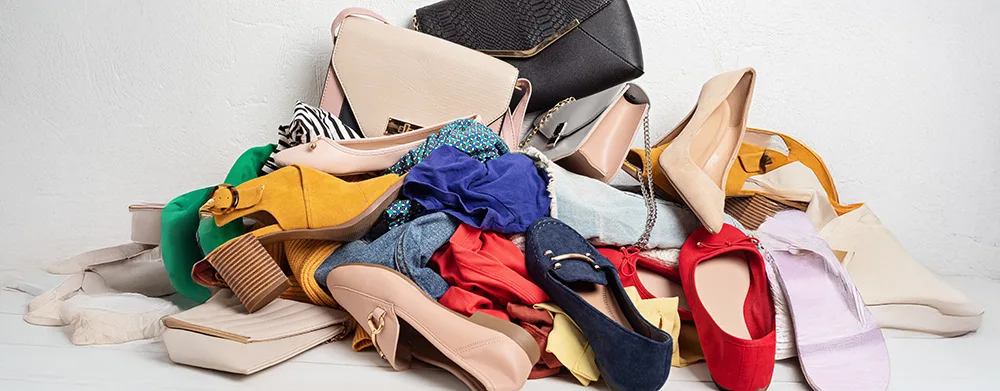
The first edition ranked fashion the second-largest CO2 emitter after oil; no primary source found ranks it so Jenosize analysis. The checked figure: 1.2 billion tonnes of CO2 equivalent from textiles production in 2015, more than all international flights and maritime shipping combined 1.
The water figure holds once it says cotton: the European Parliament puts one cotton T-shirt at 2,700 litres of fresh water by estimates, a person's drinking needs for 2.5 years 2; a WWF page of 16 Jan 2013, read in its Internet Archive copy, gave 2,700 litres for the cotton 4.
The insight 05 / 09
The future of fast fashion trends: the EU bills the cost
When the costs off the price tag start to come under the law.
The European Commission adopted the EU Strategy for Sustainable and Circular Textiles on 30 Mar 2022; its 2030 vision includes “Fast fashion is out of fashion” 8. Regulation (EU) 2024/1781's recitals want clothes worn longer than in today's fast fashion culture 7.
Already EU law, as of 23 Nov 2026
These rules are EU law only, and a Thai equivalent is not yet checked; firms selling into the EU should have legal advisers check first Jenosize analysis (read more: what is green business).
What leaders do 06 / 09
What can we do as entrepreneurs? Five moves
The first edition's five moves still hold, and the new rules speed some of them up.
Exhibit 3 · Illustrative
Five moves, from the business model to people
How to read: one pillar per move, in the first edition's order; details below.
- 01Business modelMake less, longer-lasting; rental and resale
- 02InnovationSave water and energy; new materials; data-led planning
- 03MarketingTransparent sourcing; garment care
- 04Long-term riskRules, partners and crisis plans
- 05PeopleSkills, fair work, employee ideas
1. Shifting business models to sustainability
- Develop a circular economy in the supply chain, where clothes, fabric and fibres re-enter the economy after use and never become waste 1
- Use recycled materials and environmentally friendly fabrics
- Reduce production volume while raising product quality and lifespan
- Create clothing rental or second-hand platforms; the European Parliament names clothing rental among the new business models 2 (read more: ESG and Patagonia's Worn Wear)
2. Creating added value through innovation
- Develop water- and energy-efficient production technologies (read more: 5 green energies for business)
- Research and develop environmentally friendly materials
- Use AI and big data to plan production more efficiently
- Build a system to track sustainability across the supply chain
Checked example, as of 23 Nov 2026: Fast Retailing's page says UNIQLO's merchandisers watch in-season sales and order production up or down to minimise surplus and shortages 6.
3. Adjusting marketing strategies
- Build a brand that focuses on sustainability and social responsibility
- Give transparent information about sourcing and manufacturing
- Promote garment care to extend the life of products
- Raise awareness of fast fashion's impact
4. Managing long-term risks
- Assess and manage environmental risks systematically
- Prepare for stricter environmental rules, such as the EU ban on destroying unsold clothing in force since 19 Jul 2026 7
- Work with partners who share a vision for sustainability
- Develop contingency plans for crises and market shifts
5. Investing in people
- Develop employees' sustainability skills and knowledge
- Create a fair and positive working environment
- Promote an organisational culture that cares for the environment
- Let employees take part in developing sustainable innovations
The first edition held that people are the heart of the transition Jenosize analysis, and that early investment pays back while slow brands risk losing share Jenosize analysis. It saw fashion's future in balancing profit, society and the environment, as consumers care more about sustainability each day Jenosize analysis.
The insight 07 / 09
Questions people ask about fast fashion
What does fast fashion mean, and how is it defined?
Literally, fashion that moves fast; the European Parliament defines it as the constant provision of new styles at very low prices.
What are the pros and cons of fast fashion?
The upside for shoppers: new styles at very low prices, which is how the European Parliament defines fast fashion, adding that the industry brings trends to more consumers faster than in the past. The downside: less than 1% of the material used to produce clothing was recycled into new clothing in 2015.
Which fast fashion brands does this article name?
Zara, H&M, UNIQLO and Forever 21: the first edition's examples, unranked here. As of 23 Nov 2026, the UNIQLO page on Fast Retailing's site does not use the term fast fashion.
Jenosize analysis 6
What leaders do 08 / 09
What leaders should do now
Jenosize's recommendation for a fashion business's CEO, CMO and COO.
CEO
Aim to sell more from making less
Production roughly doubled in the 15 years to 2015 as wear per garment fell 36% 1. Measure unsold, discarded and marked-down stock before approving more collections.
CMO
Claim only the sustainability you can prove
In 2024, MEPs adopted a law forbidding generic environmental claims without proof, says the European Parliament 2. Back every green claim with a figure or certification.
COO
Produce to real sales and plan for unsold stock now
As of 23 Nov 2026, Fast Retailing's page says UNIQLO adjusts production to in-season sales 6. Selling into the EU? Large enterprises there may not destroy unsold clothing since 19 Jul 2026 7.
What to watch through 2030
How Jenosize helps
Jenosize describes itself as a Business Growth Transformation Partner and was founded in 2011. Our consultants find the real constraints on growth and build the business case for the board. Our technology and AI teams build the shared rails; our marketing and events teams put new propositions in front of real customers. See Jenosize's marketing service.
09 / 09
Sources
Grades: A = primary or official · B = reputable secondary · C = needs checking, never published.
- 1A
Ellen MacArthur Foundation, A new textiles economy: Redesigning fashion's future, 28 Nov 2017 (report PDF, pages 3, 18–21, 37 and 66) Open ↗
Scene 1–2 · key numbers 1–3 · findings 2–4 · chapter 02 first-edition paragraph and list items 1–2 · chapter 03 sales-chart paragraph, table rows waste and carbon, material-flow paragraph, carbon paragraph · chapter 04 labour, wastewater and synthetic-fibre (feedstock and microfibre) paragraphs · chapter 06 circular-economy item · question 2 · CEO card · corrections (1), (2), (3), (4), (7) · Report author's own estimates (Circular Fibres Initiative analysis) · read 23 Nov 2026: clothing production approximately doubled in 15 years (Figure 1: about 50 billion units in 2000 to over 100 billion in 2015, Euromonitor sales data); utilisation down 36%; one garbage truck of textiles landfilled or incinerated every second (p. 37, note 61); less than 1% recycled into new clothing; 73% landfilled or incinerated and plastic 63% of virgin feedstock (Figure 3, 2015); 1.2 billion tonnes CO2e in 2015, more than all international flights and maritime shipping combined; untreated wastewater pollutes rivers; long hours and low pay, with modern slavery and child labour in some instances (p. 21); its robots.txt allows crawling; washing releases trillions of microfibres, most ending up in the ocean, and its Figure 10 shows them entering the ocean and food chain (p. 66)
- 2A
European Parliament, “Fast fashion: EU laws for sustainable textile consumption”, published 29 Dec 2020, last updated 12 Sep 2025 Open ↗
Finding 1 · chapter 02 definition and list items 2–3 · chapter 03 table row water and water paragraph · chapter 04 wastewater paragraph · chapter 05 split items on separate collection, green claims and producer responsibility · chapter 06 rental item · questions 1–2 · CMO card · watch item 2 · correction (5) · EU institution's own page · read 23 Nov 2026: fast fashion is the constant provision of new styles at very low prices; its rise led to large increases in textile production and disposal; 2,700 litres of fresh water for a single cotton T-shirt according to estimates, enough for one person's drinking needs for 2.5 years; about 20% of global clean water pollution, mainly from dyeing; separate textile collection since Jan 2025; producer responsibility rules approved Sep 2025; a 2024 law against generic environmental claims without proof; rental among new business models
- 3A
Boucher, J. and Friot, D., Primary microplastics in the oceans: a global evaluation of sources, IUCN, Gland, 2017 (DOI 10.2305/IUCN.CH.2017.01.en) Open ↗
Key number 4 · chapter 03 table row microplastics · chapter 04 synthetic-fibre paragraph, source chart and first-edition paragraph · correction (6) · Publisher's library record and report PDF · read 23 Nov 2026: central scenario, laundry of synthetic textiles 34.8% and tyre erosion 28.3% of primary microplastics released to the world's oceans, city dust 24.2%; the pessimistic scenario keeps the order, the optimistic one puts tyres first (38%); Figure 4 also shows road markings 7%, marine coatings 3.7%, personal care products 2%, plastic pellets 0.3%
- 4A
WWF, “The Impact of a Cotton T-Shirt”, 16 Jan 2013 (Internet Archive copy of 1 Feb 2022) Open ↗
Chapter 03 table row water and water paragraph · correction (5) · WWF's own page (Internet Archive copy) · read 23 Nov 2026 in the archived copy: it can take 2,700 litres to produce the cotton needed to make a single T-shirt; the page gives no drinking-water comparison; the Internet Archive records the live address as an error page since Jan 2025
- 5A
International Labour Organization, “Rana Plaza: More needs to be done to ensure workplace safety”, 25 Apr 2021 Open ↗
Chapter 04 Rana Plaza paragraph · UN agency's own page · read 23 Nov 2026: the collapse on 24 Apr 2013 killed 1,138 workers and left more than 2,500 injured; its country director for Bangladesh said not all factories are up to the agreed standards
- 6A
Fast Retailing Co., Ltd., “UNIQLO Business Model”, page last updated 9 Mar 2026 Open ↗
Chapter 02 UNIQLO paragraph · chapter 06 merchandising example · question 3 · COO card · correction (2) · Company's own page · read 23 Nov 2026: concept meeting one year before launch sets designs, materials and lineup; many products made in lots of roughly 1 million units; merchandisers monitor sales through the season, adjust production and minimise surplus stock and shortages; mentions LifeWear; the term fast fashion does not appear on the page
- 7A
Regulation (EU) 2024/1781 of the European Parliament and of the Council of 13 June 2024 (Ecodesign for Sustainable Products Regulation), OJ L, 28 Jun 2024, EUR-Lex Open ↗
Finding 5 · chapter 05 recital sentence and split items on the ban, the 2027 data and medium-sized enterprises · chapter 06 risk item · COO card · watch items 1 and 3 · EU legal text · read 23 Nov 2026: Article 25(1), from 19 Jul 2026 the destruction of unsold consumer products listed in Annex VII (apparel, clothing accessories, footwear) is prohibited, not for micro and small enterprises, for medium-sized ones from 19 Jul 2030; Article 26, consolidated information by 19 Jul 2027; a recital on today's fast fashion culture
- 8A
European Commission, Directorate-General for Environment, “Textiles Strategy” Open ↗
Chapter 05 first paragraph and split items on the ban and medium-sized enterprises · Commission's own page · read 23 Nov 2026: EU Strategy for Sustainable and Circular Textiles adopted 30 Mar 2022; 2030 vision includes fast fashion is out of fashion; timeline: ban on destroying unsold textiles and footwear for large enterprises from 19 Jul 2026, medium-sized from 19 Jul 2030
Left out on purpose: the first edition's optional cover and mannequin images (one real photo, the heap of clothes, carries the waste chapter); a share of global emissions for fashion from the UN (UNEP's robots.txt bars AI crawlers, and the UN Alliance for Sustainable Fashion and UN News pages refused automated reading on 23 Nov 2026, so the carbon correction uses the Ellen MacArthur Foundation's tonnage); the first edition's figures of 52 collections a year and millions of garments discarded daily (no primary page found); Forever 21's later status (its operator's own announcement and the court case site refused automated reading, and news cannot carry a company's status); any Thai rule (not yet checked); any claim singling out one brand as a polluter; legal advice; and client results as evidence (the work cards at the end are related work only; each card restates its own case page).
About this article: method, AI use, corrections, citation
- How we wrote this
- Revised from the earlier article at this address, last edited on 7 Feb 2025 (the old site records no publish date). This update keeps the definition, the shocking truths, the three hidden costs and the five moves with their original lists. It checks each figure against the report, agency, company or EU legal page that publishes it, all read on 23 Nov 2026, and adds key numbers, a table setting the first edition's figures beside the checked ones, an IUCN source chart and a five-move diagram.
- Use of AI
- Drafted by Fah, a Jenosize AI teammate, on 23 Nov 2026 from the earlier article and the sources listed. A named Jenosize expert and a Thai editor still need to read it before it goes live.
- Corrections
- 23 Nov 2026, against the first edition (last edited 7 Feb 2025): (1) It said a truckload of clothing goes to landfill every second, so millions of garments are discarded daily. The Ellen MacArthur Foundation's 2017 report, where the figure comes from, says one garbage truck of textiles is landfilled or incinerated every second 1; this version uses that unit and verb and drops the daily garment count, which the report does not give. (2) It called Zara, H&M, UNIQLO and Forever 21 market leaders releasing collections weekly or almost daily, some up to 52 a year. No primary page found ranks them or gives that pace; the report says only that more collections are offered per year 1, and, as of 23 Nov 2026, Fast Retailing's page says UNIQLO sets its lineup a year before launch 6. The ranking word and the 52 are dropped. (3) It said no phenomenon had shaken the industry more than fast fashion, which had grown exponentially over the past decade; the report estimates clothing production roughly doubled in the 15 years to 2015 1. (4) It said fashion is the second-largest CO2 emitter after the oil industry. No primary source found ranks it so; this version gives the report's 1.2 billion tonnes of CO2 equivalent for 2015 1. (5) It said one T-shirt takes 2,700 litres of water; the European Parliament 2 and the WWF page where the figure appears 4 say a cotton T-shirt. (6) It called synthetic clothing one of the largest sources of microplastics released into the oceans; this version scopes that to primary microplastics, where IUCN's central scenario puts washing synthetic textiles first, at 34.8% 3. (7) It said workers are paid well below a living wage with inadequate benefits, and that child labour is often found in the production chain; this version uses the report's words: low pay and, in some instances, child labour 1. Any further change to a fact is logged here with its date.
Cite this article
Jenosize (2026). “Fast fashion trend: faster, cheaper clothes and the costs left off the price tag.” Behind the S‑Curve, updated 23 November 2026. https://www.jenosize.com/en/content/growth-strategy/fast-fashion-trend
From Jenosize work
Work by Jenosize on this topic.
Related


One email a week
S-Curve Weekly
The week's signals and one deep read, chosen for leaders.
One email a week. Leave whenever you like.
Where is your business on its curve?
Talk it through with our growth team: a first conversation, no deck required.