
Behind the S-Curve · People & Culture
OKR vs KPI: What’s the Difference and When to Use Each?
What is OKR vs KPI? Learn the key differences, pros, cons, and real examples to help you choose the right performance system for your organization.

Contents (6)
OKR vs KPI: Which One Fits Your Organization?
When driving an organization in a data-driven and rapidly evolving business landscape, having accurate and effective performance measurement tools is critical. Two of the most commonly discussed terms in business management are “OKR” (Objectives and Key Results) and “KPI” (Key Performance Indicators). While both are used to measure success, they are fundamentally different in structure and purpose. To choose the right system, business leaders and team managers must clearly understand the difference between OKR and KPI.

Understanding the Basics: What Is OKR and What Is KPI?
What is OKR?
OKR, or Objectives and Key Results, is a strategic goal-setting framework consisting of two core components:
- Objectives – The main goals an organization aims to achieve.
- Key Results – Specific, measurable outcomes that indicate progress toward the objectives.
OKRs are often used in organizations that focus on innovation, transformation, or growth. They help align employees toward a shared direction and foster a culture of positive challenges.
What is KPI?
KPI, or Key Performance Indicator, is a performance measurement tool derived from an organization's specific objectives. The main purpose of KPIs is to evaluate the results of completed activities. KPIs are suitable for measuring success at the organizational, team, or individual level and are often used in tasks that require operational accuracy and consistency.
OKR vs KPI: What’s the Difference?
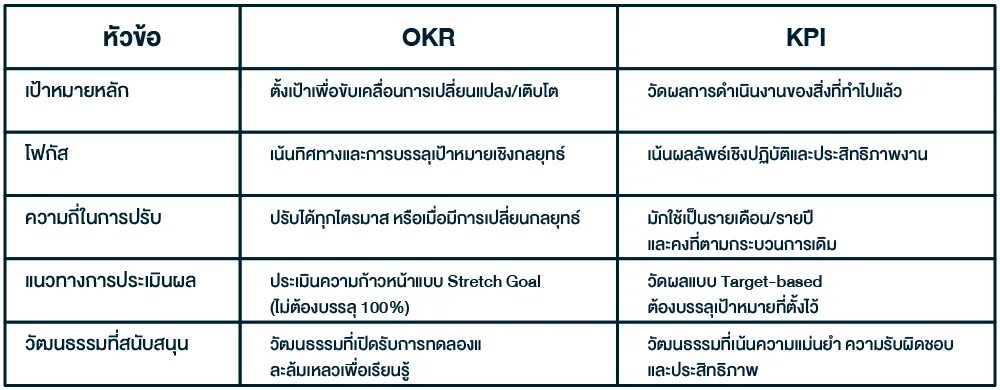
To better understand the difference between OKR and KPI, the table below outlines key distinctions:
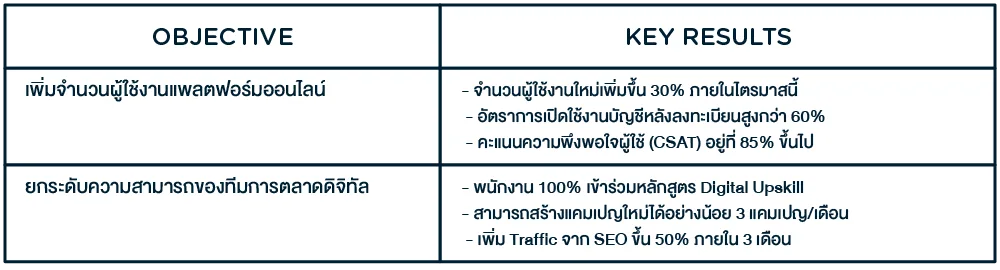
Examples of OKRs and KPIs
OKR Examples (Strategic, Growth-Oriented)
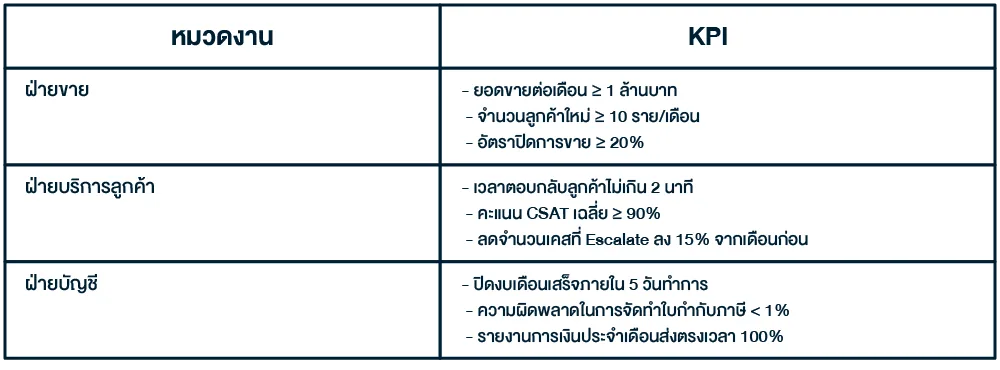
KPI Examples (Operational, Result-Based)
When to Use OKR and When to Use KPI?
Choosing between OKR vs KPI isn’t about deciding which system is better — it’s about aligning your performance metrics with your organization's goals and transformation stage.
When Is OKR the Right Fit?
- The company is undergoing a business transformation or innovation phase.
- You want to inspire motivation and challenges within teams.
- The goals are not yet quantified but have a clear strategic direction.
- You aim to communicate a shared vision across the entire organization.
When Is KPI the Right Fit?
- The work processes are well-defined and require precise quality control.
- You’re evaluating the success of time-bound projects.
- You need to assess individual performance metrics such as sales, productivity, or response time.
- You want to monitor costs or streamline operations.

Case Study: How Leading Companies Combine OKR and KPI Effectively
Global companies like Google, Intel, and Adobe are prime examples of organizations that have mastered the hybrid use of OKR and KPI. They implement a two-tiered measurement system to support both strategic and operational goals:
- Google uses OKRs to set company-wide direction and breaks them down into team-specific quarterly OKRs (e.g., Product, Marketing). KPIs are then used to measure each individual’s performance.
- Intel, one of the earliest adopters of OKRs in the 1970s, uses OKRs for growth and innovation while maintaining KPIs for production quality.
- Adobe applies OKRs to promote learning and innovation while keeping KPIs in departments that require high operational efficiency, such as customer service and marketing.
By understanding the difference between OKR and KPI, companies can design a hybrid system that supports sustainable growth. OKRs provide the strategic vision, while KPIs track actionable, measurable results. Integrating employee engagement strategies into this framework further boosts motivation by aligning individual and organizational goals
At Jenosize, our team of strategic consultants is here to help your business implement OKRs and KPIs professionally and effectively. With experience supporting both public and private sectors, we ensure every step of your strategy is data-driven, actionable, and aligned with your goals. Contact us today via our website to get started.
Related


 Fah

One email a week
S-Curve Weekly
The week's signals and one deep read, chosen for leaders.
One email a week. Leave whenever you like.
Where is your business on its curve?
Talk it through with our growth team: a first conversation, no deck required.