
Behind the S-Curve · Explained · People & Culture
What is an ESOP, and which share plan can a company really offer?
An ESOP gives directors and employees company shares or the right to buy them: in Thailand it is an employee stock option program of newly issued shares or warrants, and in the US an employee stock ownership plan, a retirement plan that invests mainly in the employer's stock.

Contents (8)
- The tension
- The insight
- The tension
- What leaders do
- The insight
- What leaders do
- Sources
The tension 01 / 08
Key takeaways in 60 seconds
An ESOP offers directors and employees shares or the right to buy them. The Stock Exchange of Thailand (SET) calls it an Employee Stock Option Program: common shares, warrants or convertible debentures 1
In the US, the same letters mean a retirement plan: an employee stock ownership plan, a tax-qualified plan that invests primarily in the employer's own stock 3
A Thai listed company needs its shareholders. In the general case, objections may not exceed 10% of the votes at the meeting 1
Thai employees are taxed in the year they own the shares, even if the shares cannot be sold yet 4
A tax-qualified US ESPP discounts by 15% at most: the price may not fall below 85% of market value 6
A good ESOP serves one goal: keeping key people, rewarding everyone or preparing a listing, each with its own type and cost Jenosize analysis
The insight 02 / 08
What is an ESOP? Employee stock ownership vs option plans
Thailand uses the name for new shares offered to staff; the US uses it for a retirement plan.
ESOP
An ESOP (Employee Stock Option Program) is an offer of newly issued securities, meaning common shares, warrants or convertible debentures, to directors or employees of a company or its subsidiary 1

For a company, an ESOP is a benefit beyond salary: employees receive shares, or options to buy them, once they meet conditions such as staying for a set period or helping the company reach a goal (read more: OKR vs KPI). Employees look for stability and good benefits, and companies that fall short often lose good people to other organisations Jenosize analysis
SET says an ESOP motivates directors and employees through a share in owning the business 1. Owning part of the company gives people a reason to commit and stay longer Jenosize analysis
The full name is searched three ways: employee stock option plan, employee stock option program and employee stock ownership plan. In the US, an employee stock ownership plan is a section 401(a) retirement plan that invests primarily in employer stock, and the Internal Revenue Service (IRS) and the Department of Labor share jurisdiction over some of its features 3. Here, ESOP means the Thai sense unless marked US.
Exhibit 1
One name, two different plans in Thailand and the US
How to read: compare each row across the two countries.
| Question | Thailand: Employee Stock Option Program | US: Employee Stock Ownership Plan |
|---|---|---|
| What it is | Thailand: Employee Stock Option ProgramAn offer of newly issued securities to directors or employees 1 | US: Employee Stock Ownership PlanA tax-qualified retirement plan under section 401(a) 3 |
| What employees get | Thailand: Employee Stock Option ProgramCommon shares, warrants or convertible debentures 1 | US: Employee Stock Ownership PlanEmployer stock that the plan invests in primarily 3 |
| Who approves or oversees | Thailand: Employee Stock Option ProgramThe shareholders' meeting, under notification TorJor. 32/2551 1 | US: Employee Stock Ownership PlanThe IRS and the US Department of Labor share jurisdiction over some features 3 |
| What the company carries | Thailand: Employee Stock Option ProgramA capital increase that may dilute existing shareholders 1 | US: Employee Stock Ownership PlanIf the stock is not readily tradable, buying it back under a fair valuation formula 5 |
The insight 03 / 08
Types of ESOP: four ways to share stock or its value
ESOP shares come in four forms, and they differ in one thing: whether employees hold real shares.
Exhibit 2 · Illustrative
Four types of ESOP: real shares, or a value tied to the share price
How to read: one pillar per type, with what the employee gets.
- RSGRestricted Stock GrantsReal shares, sellable only after the service condition; leaving early may mean returning them
- SARsStock Appreciation RightsNo shares: the share-price rise between grant and exercise, in cash or stock
- PSPhantom StockNo shares: cash equal to the return on hypothetical shares
- ESPPEmployee Stock Purchase PlanReal shares bought below market from payroll savings; at most 15% off in a tax-qualified US plan 6
1. Restricted Stock Grants
The company gives employees shares directly, with conditions: they must work for the period the company sets before they can sell, transfer or change ownership of the shares, and anyone who leaves early may have to return them. Companies set long-term, short-term or their own criteria, so rights differ by person and company.
In Thailand, the restriction does not delay the tax: the Board of Taxation counts the shares as income in the tax year ownership passes, transfer conditions or not 4. Shares that cannot be sold yet but are already taxed are where an ESOP turns from incentive into burden Jenosize analysis
2. Stock Appreciation Rights (SARs)
SARs pay the difference between the future share price and the price on the grant date, in cash or company stock, when employees exercise. They carry no ownership. Employees invest nothing yet gain when the stock rises; the drawbacks are complexity and market risk. Even so, SARs remain an effective way to motivate employees Jenosize analysis
3. Phantom Stock (phantom shares)
Phantom stock also gives no real shares but calculates differently: it pays cash equal to the stock's performance over a set period, the stated number of shares times the change in price, timed by employment conditions and tenure. SARs pay on the price difference; phantom stock on the value of the hypothetical units granted.
4. What is an ESPP (Employee Stock Purchase Plan)?
ESPP
An ESPP (Employee Stock Purchase Plan) lets employees buy company shares below market price; in the US, a tax-qualified plan may not set the price below 85% of market value 6
Employees save through payroll deductions for a set period, then buy below market and may sell later for a profit. The limits are cost and admin effort: the company may need a system built for the plan.
The first edition gave a 15–20% discount as an example; a discount above 15% rules out a tax-qualified US plan. Under US Internal Revenue Code section 423, a tax-qualified ESPP may not price shares below 85% of market value, so the discount tops out at 15%, and each employee can buy at most $25,000 of stock, valued at grant, per calendar year 6
The tension 04 / 08
ESOPs: advantages and disadvantages to weigh first
The incentive comes with employee tax, diluted shareholders and a cost on the books.
An ESOP looks like a benefit that costs no cash, but the cost moves to shareholders, the books and employees' tax bills Jenosize analysis
Advantages
- Attracts and keeps talent: skilled people want to join, and high-potential staff stay longer Jenosize analysis
- Motivates: with a stake in ownership, employees push the company to grow 1
- Builds loyalty: employees feel part of the organisation Jenosize analysis
- Lifts morale: staff share in the company's growth Jenosize analysis
Disadvantages and costs
- Dilutes existing shareholders: an ESOP of new shares is a capital increase 1
- Tax before cash: income arises in the year employees own the shares, even if they cannot sell yet 4
- A cost on the books: SET points companies to TFRS 2, the share-based payment standard 1
- Value rides on the share price: if the stock falls, so does the incentive, and SARs or an ESPP take effort to run
Rules for Thai listed companies
A listed company's ESOP needs a shareholders' meeting. Per SET's ESOP page (read 21 Nov 2026), the general case is an offer of up to 5% of shares, or more than 5% at no more than 10% below market, with objections of no more than 10% of the votes present. Above 5% at a deeper discount, objections must stay within 5%, and anyone receiving more than 5% of the offering needs three-quarters approval individually 1. The offer must close within a year and warrants may run up to 5 years; no application to Thailand's Securities and Exchange Commission (SEC) is needed, but a checklist and sales report must reach it within 15 days 1
Tax employees should know
A Revenue Department ruling of 8 Feb 2016, for a person who was both a director and an employee of a listed company, set the income from exercising ESOP warrants at that month's average market price minus the exercise price: employment income under section 40(1), with tax withheld by the company 7. Shares that neither trade on the exchange nor have a public offering price are valued at book value for the prior accounting period 4
A US ESOP adds a cash burden: if the stock is not readily tradable, a participant due a distribution can require the employer to buy it back under a fair valuation formula 5. The company therefore needs cash ready for leavers Jenosize analysis
Shares that cannot be sold yet but are already taxed are where an ESOP turns from incentive into burden Jenosize analysis
What leaders do 05 / 08
Which companies suit an ESOP, and which type to pick
Start from the plan's goal, then choose the tool.
An ESOP suits a company that wants to motivate and keep capable people. The first edition (last edited 22 Jul 2024) named four kinds of Thai business starting to use ESOPs Jenosize analysis
- Startups have limited finances, so they offer a share of the business to attract and keep skilled people, whose rewards grow with the company (read more: 8 trending startup businesses)
- Technology and innovation businesses compete hard for specialists such as software engineers, data scientists and AI specialists, and an ESOP helps keep them
- Professional services such as law firms, consulting firms and financial institutions must keep highly knowledgeable people; an ESOP makes them feel more involved and committed
- Companies planning to raise capital or list their shares gain staff who work to raise the company's value, because they share in the rising share price
The first edition also listed government agencies, which needs correcting: an ESOP is an offer of securities a company or its subsidiary issues to directors or employees 1, so a body without shares falls outside it.
Exhibit 3 · Illustrative
Choose by what the company will give up: new shares, cash or admin time
How to read: one row per type, with who it suits and what it costs the company.
| Type | Who it suits | What the company trades |
|---|---|---|
| Restricted Stock Grants | Who it suitsOperational staff with outstanding performance; a sense of ownership | What the company tradesCapital to issue new shares or buy them back |
| SARs | Who it suitsStaff across the organisation; long-term motivation as the price rises | What the company tradesFits limits on new shares and scarce capital, at the price of complexity |
| Phantom Stock | Who it suitsStaff across the organisation; simpler than SARs, suits small companies | What the company tradesNo change to capital structure or shareholdings, but paid in cash |
| ESPP | Who it suitsOperational staff: 6–12-month periods, modest discounts · managers and key people: 1–2 years, higher discounts | What the company tradesCost and admin; with limited capital, set per-person quotas or a lower discount |
Fit the choice to the organisation's character, culture and long-term goals, and design conditions, timing and share numbers carefully so both sides benefit. Conditions tied to tenure and performance can be checked only when employee records sit in one system Jenosize analysis (read more: 7 best HR programs)
The insight 06 / 08
Frequently asked questions
What is the difference between an ESOP and an EJIP?
An ESOP issues new shares or warrants and needs shareholder approval, so it may dilute holders. In an EJIP (Employee Joint Investment Program), staff and the company buy existing shares on the exchange in instalments; the board can approve it unless directors join, and nothing is diluted
What leaders do 07 / 08
How leaders use an ESOP
One move each for the CEO, CFO and HR head: Jenosize's recommendation.
CEO
Pick one goal before you pick a type
Decide whether the ESOP plan exists to keep key people, reward everyone or prepare a listing, then choose the type that serves it Jenosize analysis
CFO
Model dilution and cost before the shareholders' meeting
Check the offer against the 5% threshold and the discount against 10%, then assess the effect under TFRS 2 1
CHRO
Explain the tax before staff receive shares
Tell employees that tax falls in the year they gain ownership, even before they can sell 4. Keep the tenure and performance records the vesting conditions rely on Jenosize analysis
How Jenosize helps
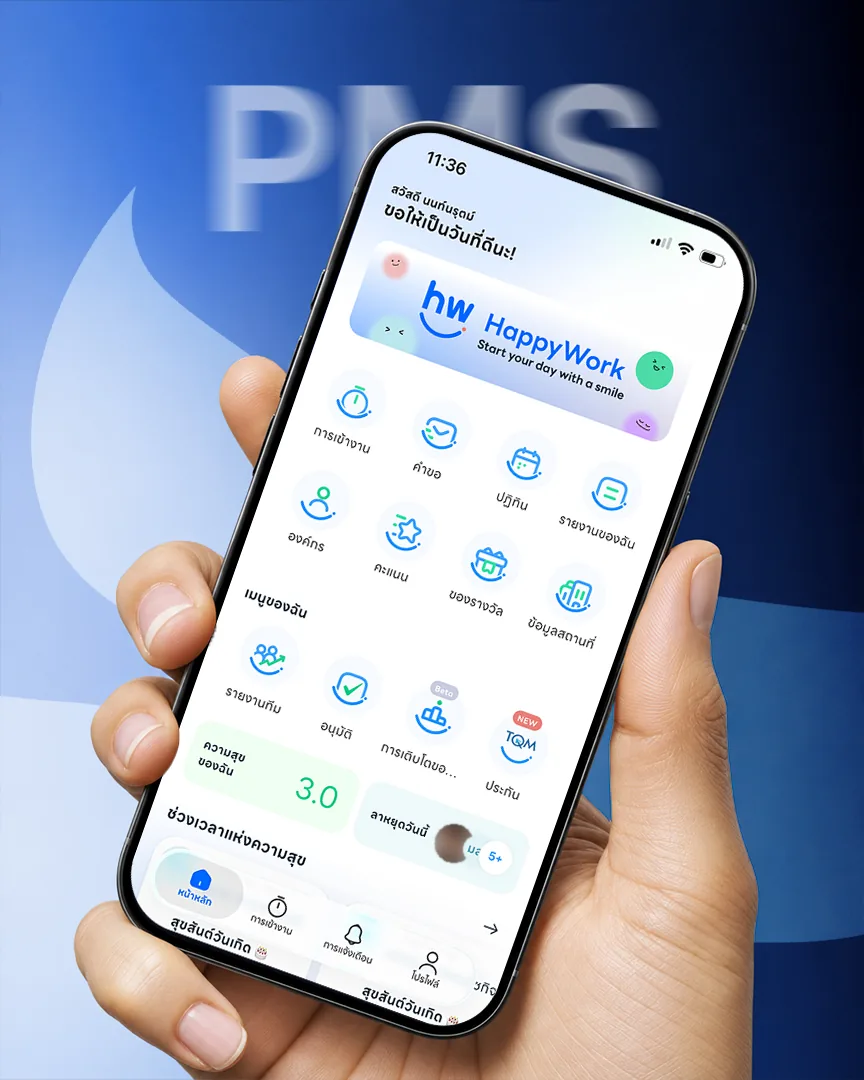
Jenosize describes itself as a Business Growth Transformation Partner and was founded in 2011. Our consultants find the real constraints on growth and build the business case for the board, and HappyWork, the HR software Jenosize built, keeps check-in, leave, approvals, company news and payroll-ready reports in one app.
08 / 08
Sources
Grades: A = primary or official · B = reputable secondary · C = needs checking, never published.
- 1A
The Stock Exchange of Thailand (SET), “ESOP: Employee Stock Option Program”, listed-company financial instruments page (citing Capital Market Supervisory Board notification TorJor. 32/2551 and the Public Limited Companies Act B.E. 2535). Thai page; the English version is at the same path under /en/ Open ↗
Definition and three forms of ESOP · who qualifies · the motivation benefit · approval and the 10% / 5% objection thresholds · the 5%-of-shares and 10%-discount tests · allocations above 5% to one person · dilution · one-year offer period and five-year warrant term · the 15-day checklist · TFRS 2 · 14-day meeting notice · Official exchange page · no last-updated date shown · read 21 Nov 2026
- 2A
The Stock Exchange of Thailand (SET), “EJIP: Employee Joint Investment Program” Open ↗
Definition of EJIP · board approval · no dilution · Official exchange page · no last-updated date shown · read 21 Nov 2026
- 3A
Internal Revenue Service (IRS), “Employee stock ownership plans (ESOPs)” (last reviewed 23 Jul 2026) Open ↗
A US ESOP is a section 401(a) qualified defined contribution plan designed to invest primarily in qualifying employer securities · the IRS and the Department of Labor share jurisdiction over some ESOP features · Government agency · read 21 Nov 2026
- 4A
Thailand Board of Taxation, ruling 28/2538 on personal income tax when shares are given, or sold below market price under a special arrangement (7 Feb 1995), published by the Revenue Department Open ↗
Income arises in the tax year ownership passes, with or without transfer conditions · how shares are valued, listed or not · Revenue Department tax law compendium (page updated 10 Feb 2022) · read 21 Nov 2026
- 5A
26 U.S. Code §409(h), “Right to demand employer securities; put option” (US Code 2023 edition, US GPO govinfo.gov) Open ↗
A participant's right to have the employer repurchase stock that is not readily tradable under a fair valuation formula · Statute · current text on Cornell LII read the same day matches · read 21 Nov 2026
- 6A
26 U.S. Code §423, “Employee stock purchase plans” (US Code 2023 edition, US GPO govinfo.gov) Open ↗
Option price no lower than 85% of fair market value (a 15% maximum discount) · the $25,000-a-calendar-year cap · Statute · last amended 2017 (Pub. L. 115-97) per the notes on Cornell LII · read 21 Nov 2026
- 7A
Revenue Department of Thailand, tax ruling Kor Kor 0702/1034 of 8 Feb 2016 (B.E. 2559) on personal income tax when directors and employees exercise rights to buy ordinary shares Open ↗
How income from exercising listed-company options is calculated · employment income under section 40(1) · the company's duty to withhold under section 50(1) · Revenue Department ruling answering this taxpayer · read 21 Nov 2026
Left out on purpose: the earlier body photo (a stock person), the closing free-trial line and the “best technology” claim (the current HappyWork page states neither; the HappyWork link moved to How Jenosize helps), and ESOP rules for private companies not yet listed, because the Thai SEC website refused automated reading on 21 Nov 2026, so those rules were not checked against the notification itself.
About this article: method, AI use, corrections, citation
- How we wrote this
- Revised from the earlier article at this address (the old site records no publish date; its last edit was 22 Jul 2024) on 21 Nov 2026. Every earlier fact is kept, four are corrected against sources, and the update adds the Thai and US meanings of ESOP, the rules for Thai listed companies, employee tax and sourced disadvantages. Facts were checked against the sources above on 21 Nov 2026. Rules and tax change: check with the SEC, the Revenue Department or an adviser before acting. The four-type pillars and the selection table are concept drawings, not measured data.
- Use of AI
- Drafted by Fah, a Jenosize AI teammate, on 21 Nov 2026 from the earlier article and the sources listed. This is general information, not legal or tax advice. A named Jenosize expert and a Thai editor still need to read it before it goes live.
- Corrections
- 21 Nov 2026: (1) the first edition called every type an Employee Stock Ownership Plan; corrected to SET's name, Employee Stock Option Program, with the US retirement plan explained separately 1 3. (2) The 15% cap of a tax-qualified US ESPP is added next to the first edition's 15–20% example; a discount above 15% rules out that kind of plan 6. (3) Government agencies, and “Conglomerates” in the third group's heading, are removed from the businesses that use ESOPs, and “all types of business” (Thai edition) now reads businesses that are companies, because an ESOP needs a company issuing securities 1. (4) The English edition's SARs paragraph stopped mid-sentence (“SARs remain an”); it is completed from the Thai edition.
Cite this article
Jenosize (2026). “What is an ESOP, and which share plan can a company really offer?” Behind the S‑Curve, updated 21 November 2026. https://www.jenosize.com/en/content/people-culture/what-is-esop

Related



One email a week
S-Curve Weekly
The week's signals and one deep read, chosen for leaders.
One email a week. Leave whenever you like.
Where is your business on its curve?
Talk it through with our growth team: a first conversation, no deck required.